
AI in Real Estate: Benefits, Use Cases and Business Impact
0101 Labs ·

On this page11 sections
- What Is AI in Real Estate?
- Where Can AI Create Value in Real Estate?
- 1. Lead Qualification and Sales Prioritisation
- 2. Personalised Property Recommendations
- 3. Pricing and Market Intelligence
- 4. Project Planning and Construction Monitoring
- 5. Customer Follow-Ups and CRM Automation
- 6. Property Management and Predictive Maintenance
- What Are the Key Benefits of AI in Real Estate?
- How Should Real Estate Businesses Start With AI?
- How 0101 Labs Approaches AI for Real Estate
Artificial Intelligence is changing how real estate businesses sell properties, plan projects, manage assets and make decisions. Developers, builders, brokers and property management companies are using AI to analyse data faster, automate repetitive work and improve visibility across the property lifecycle.
The opportunity is not to add AI everywhere. It is to identify the business problem that matters most, such as slow lead response, poor qualification, pricing uncertainty, project delays or inefficient property management, and then use the right technology to improve a measurable KPI.
At 0101 Labs, we use a simple framework:
Business Problem → AI Opportunity → KPI → Measurable Business Outcome
What Is AI in Real Estate?
AI in real estate refers to technologies such as machine learning, predictive analytics, natural language processing, computer vision and intelligent automation that support decisions and workflows across sales, project planning, construction, property management and investment analysis.
AI does not need to replace real estate professionals. It can support people with better information, prioritisation and automation while humans remain responsible for relationships, negotiation, approvals and high-impact decisions.
Where Can AI Create Value in Real Estate?
AI can help real estate businesses streamline sales, improve customer experiences, and optimise property operations. Here are six key AI use cases in real estate that can help businesses improve efficiency and make data-driven decisions.
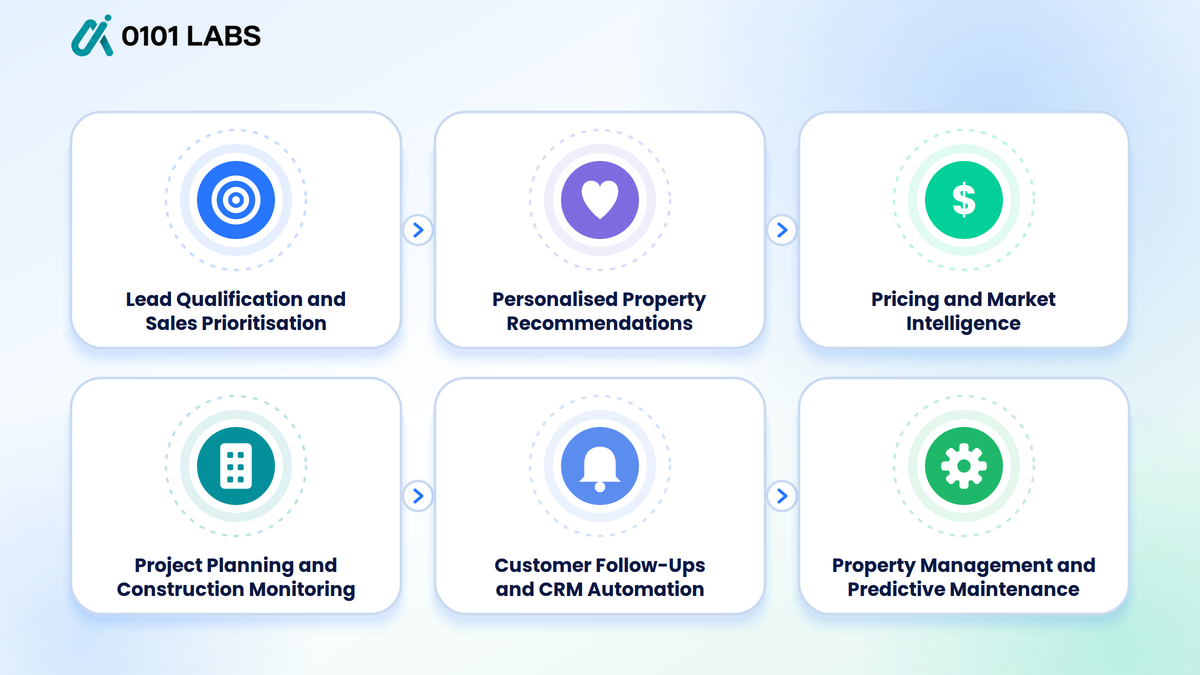
1. Lead Qualification and Sales Prioritisation
Real estate sales teams often manage large numbers of enquiries with very different levels of intent.
AI can evaluate customer requirements, location preferences, budget, property type, engagement history and purchase timeline to help teams prioritise opportunities.
A workflow may capture an enquiry, organise the information, score the lead, route it to the right salesperson and create the next follow-up task.
The goal is to help sales teams focus on the opportunities most likely to move forward.
2. Personalised Property Recommendations
Homebuyers and investors often compare multiple projects, locations, budgets and configurations before deciding.
AI can use customer preferences and previous interactions to recommend more relevant properties based on factors such as budget, location, unit type, size and amenities.
This can improve the customer journey while reducing manual filtering. The salesperson should still own the relationship. AI helps make the conversation more relevant.
3. Pricing and Market Intelligence
Property pricing depends on location, inventory, demand, comparable transactions, product configuration and market conditions.
AI and predictive analytics can help teams identify demand patterns, support pricing reviews, forecast inventory movement and evaluate market opportunities.
Automated valuation and predictive models should be treated as decision-support tools, particularly where data quality, local context or regulatory considerations matter.
4. Project Planning and Construction Monitoring
Real estate projects involve multiple teams, milestones, budgets and dependencies.
AI can analyse schedules, progress updates, cost information and site data to identify risks earlier. Computer vision can analyse site images or video for progress monitoring, while predictive models can flag possible delays or cost deviations.
5. Customer Follow-Ups and CRM Automation
A large part of real estate sales depends on disciplined follow-up.
AI-enabled workflows can support meeting summaries, CRM updates, follow-up reminders, next-step identification, site-visit reminders and re-engagement of inactive leads.
This reduces the risk of opportunities being lost because follow-ups were delayed or CRM records were incomplete. The relationship, negotiation and closing process should remain salesperson-led.
6. Property Management and Predictive Maintenance
For completed residential, commercial or mixed-use assets, AI can support property and facility management by analysing building and maintenance information.
Applications may include predicting maintenance requirements, prioritising service requests, monitoring equipment performance, improving maintenance schedules and supporting energy or space optimisation.
What Are the Key Benefits of AI in Real Estate?
Common benefits include:
Faster decision-making: Teams can analyse more information in less time.
Better sales productivity: Lead prioritisation, CRM updates and follow-up automation reduce repetitive work.
Improved customer experience: More relevant recommendations and faster responses can improve the property journey.
Better project visibility: AI can help identify risks, delays and performance issues earlier.
Operational efficiency: Reporting and property-management workflows can reduce manual effort.
Stronger forecasting: Predictive models can support demand, sales, pricing and project planning.
How Should Real Estate Businesses Start With AI?
A practical AI journey can begin with six steps.
Step 1: Identify the business problem.
Choose a specific bottleneck, such as slow lead response, missed follow-ups, project reporting delays or high maintenance effort.
Step 2: Map the current process.
Understand the people, systems, data and handoffs involved.
Step 3: Define the KPI.
Examples include response time, conversion rate, hours saved, cost reduction or project variance.
Step 4: Decide what AI should handle.
Separate repetitive or data-heavy work from activities requiring human judgment.
Step 5: Integrate with existing systems.
The solution may use CRM, ERP, project-management platforms, property-management systems, APIs, AI models and automation tools.
Step 6: Test and measure.
Start with one use case, compare results against the baseline and expand only when the outcome justifies it.
How 0101 Labs Approaches AI for Real Estate
At 0101 Labs, we do not begin by recommending a specific AI tool.
We first understand the business problem, the existing process, the systems already in use and the KPI that needs to improve.
The final solution may combine existing AI models, automation platforms, APIs, CRM or ERP systems, analytics tools and custom development. The technology should fit the business requirement, not the other way around.
Business Problem → AI Opportunity → KPI → Measurable Business Outcome
Start with one high-friction area such as lead qualification, sales follow-up, project reporting, pricing analysis or maintenance planning. If it improves a measurable KPI, it can become the foundation for broader AI adoption.
Frequently Asked Questions
1. What is AI in real estate?+
AI in real estate uses technologies such as machine learning, predictive analytics, natural language processing, computer vision and automation to improve sales, planning, pricing, customer engagement and property management.
2. How is AI used in real estate sales?+
AI can support lead capture, qualification, scoring, property recommendations, CRM updates, follow-up reminders and sales prioritisation. Salespeople should continue to manage relationships, negotiation and closing.
3. Can AI help predict property prices?+
AI can analyse transaction data, market information, location signals and other inputs to support pricing and valuation decisions. Results depend on data quality and should be combined with professional judgment.
4. How can AI help real estate developers?+
Developers can use AI for demand forecasting, lead management, project planning, construction monitoring, pricing analysis, customer engagement and property operations.
5. Can AI improve property management?+
Yes. AI can support predictive maintenance, service-request prioritisation, building-performance monitoring, maintenance scheduling and operational reporting.
6. What is the best way to start using AI in real estate?+
Start with one clearly defined business problem and a measurable KPI. Map the current process, determine where AI can help, connect the necessary systems, test the solution and measure the result before expanding.